- The Option Premium
- Posts
- Bear Call Spreads: How to Profit When You're Bearish (or Just Cautious)
Bear Call Spreads: How to Profit When You're Bearish (or Just Cautious)
Learn how to trade bear call spreads for defined-risk income in neutral-to-bearish markets. Includes strike selection, management rules, and a real SPY example from a 24-year veteran.

Andrew Crowder
March 01, 2026

Bear Call Spreads: How to Profit When You're Bearish (or Just Cautious)
Most options traders learn to sell puts first. It's intuitive. You like a stock, you sell a put, you collect premium. Simple.
But what happens when you don't like a stock? Or when the market feels stretched and you want to express a neutral-to-bearish opinion with defined risk? That's where bear call spreads quietly become one of the most underutilized tools in a premium seller's arsenal. Not because they're complicated, but because most traders never think to look up.
Why Bear Call Spreads Deserve Your Attention
A bear call spread (also called a short call spread or call credit spread) is a defined-risk, defined-reward strategy that profits when the underlying stays below your short strike at expiration. You sell a call at one strike and buy a call at a higher strike in the same expiration. The credit you receive is your maximum profit. The width between the strikes minus the credit is your maximum loss.
That's it. No assignment risk on shares you can't afford. No naked upside exposure. Just a clean probability bet that prices stay below a certain level.
If you've already traded bull put spreads, a bear call spread is the mirror image. Same mechanics, opposite direction. Together, they give you the ability to sell premium in any market environment.
How the Trade Works: Anatomy of a Bear Call Spread
Let's walk through a real-world setup.
Say SPY is trading at $595, and your analysis suggests the market is likely to consolidate or pull back over the next 30 to 45 days. You could:
Sell the SPY $610 call (30 DTE) for $3.20
Buy the SPY $615 call (30 DTE) for $2.10
Net credit received: $1.10 ($110 per contract)
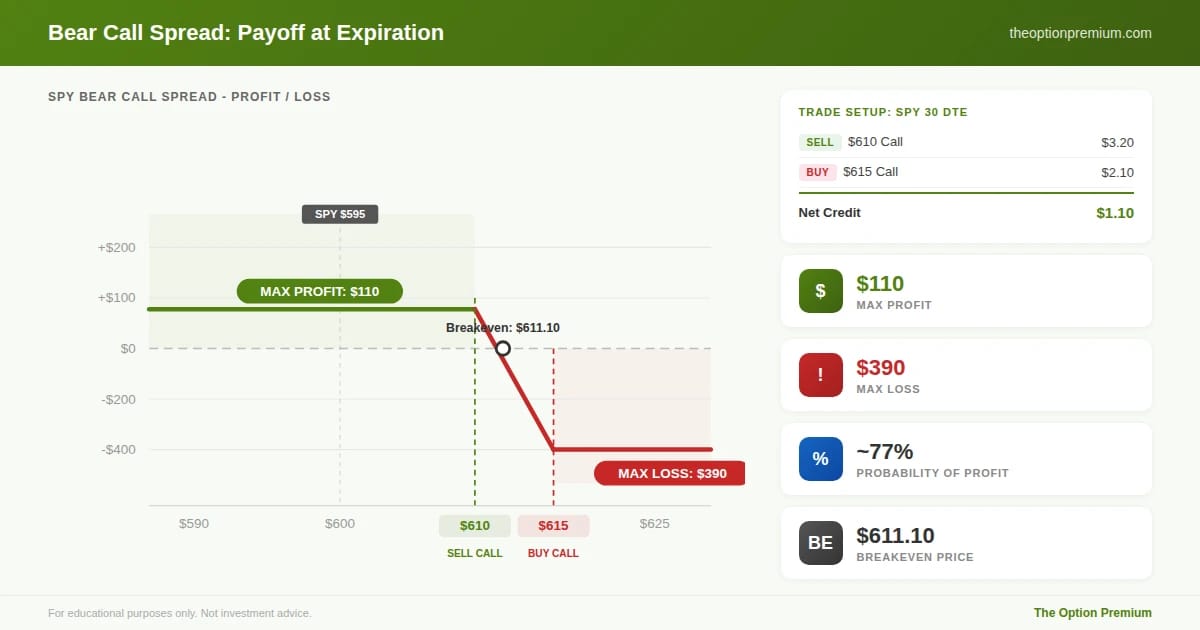
Bear call spread payoff diagram showing max profit of $110 and max loss of $390 on SPY options trade
Your numbers look like this:
Max profit: $110 (the credit received)
Max loss: $390 (width of $5.00 minus $1.10 credit, times 100)
Breakeven: $611.10 (short strike + credit received)
Probability of profit: Roughly 75-80%, depending on current IV levels
You need SPY to stay below $610 at expiration for full profit. Even if it rallies modestly, you win. The market only has to cooperate enough to stay below your short strike.
Strike Selection: Where the Edge Lives
Choosing your strikes isn't about picking numbers that "feel right." It's about aligning your trade with probability and the current implied volatility environment.
Here's the framework I use:
Short strike placement. I want my short call at a delta between 0.15 and 0.25. That typically places it one to two standard deviations above the current price, giving me a 75-85% statistical probability that the option expires worthless. If IV Rank is elevated, I can move the strike further out and still collect a meaningful credit.
Spread width. I keep my spreads between $3 and $5 wide on most underlyings. Narrower spreads reduce capital at risk but compress your reward. Wider spreads offer better risk/reward ratios but increase your max loss. The key is matching the width to your position sizing rules.
Expiration selection. The 30- to 45-day window is the sweet spot. This is where theta decay accelerates most favorably for premium sellers. Too short and gamma risk increases. Too long and your capital is tied up without meaningful time decay working for you.
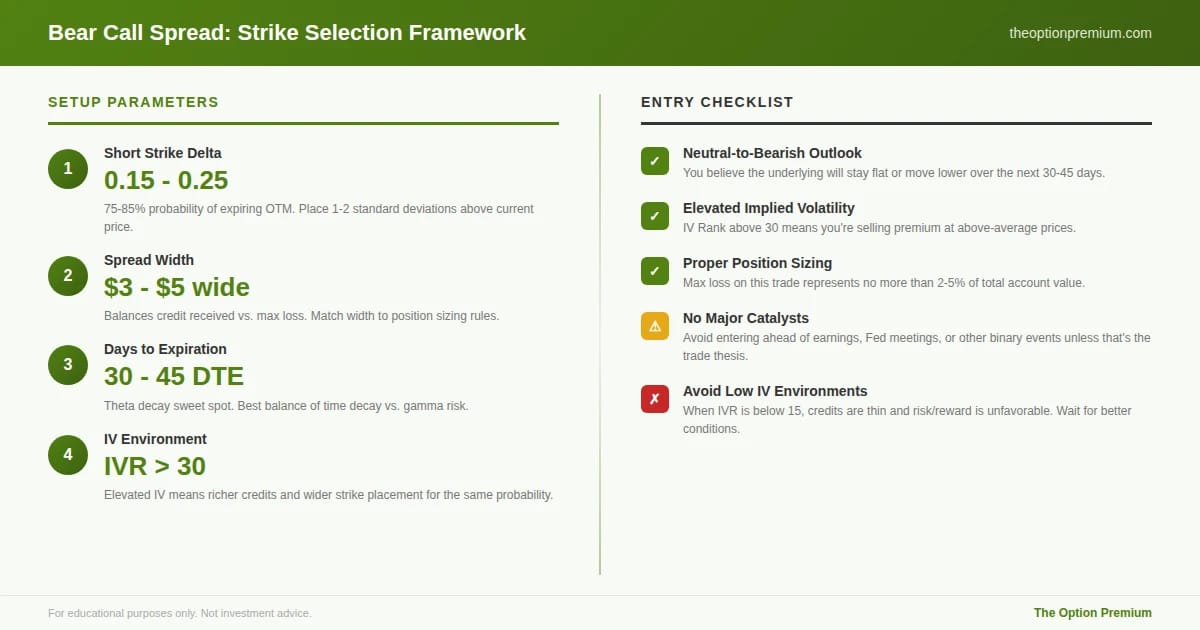
Bear call spread strike selection framework with setup parameters and entry checklist for options traders
The Practitioner Edge: What 23 Years Taught Me About Selling Calls
In my own trading, bear call spreads serve a very specific role: they're my go-to tool when I want to express a directional opinion without taking on unlimited risk.
Here's what I've learned that textbooks won't tell you:
Pair them with bull put spreads to create iron condors. I often start with one side of the trade and add the other when conditions are right. Rather than forcing a full iron condor at once, I leg into positions based on where implied volatility is richest. If IV skew favors the call side, I start there.
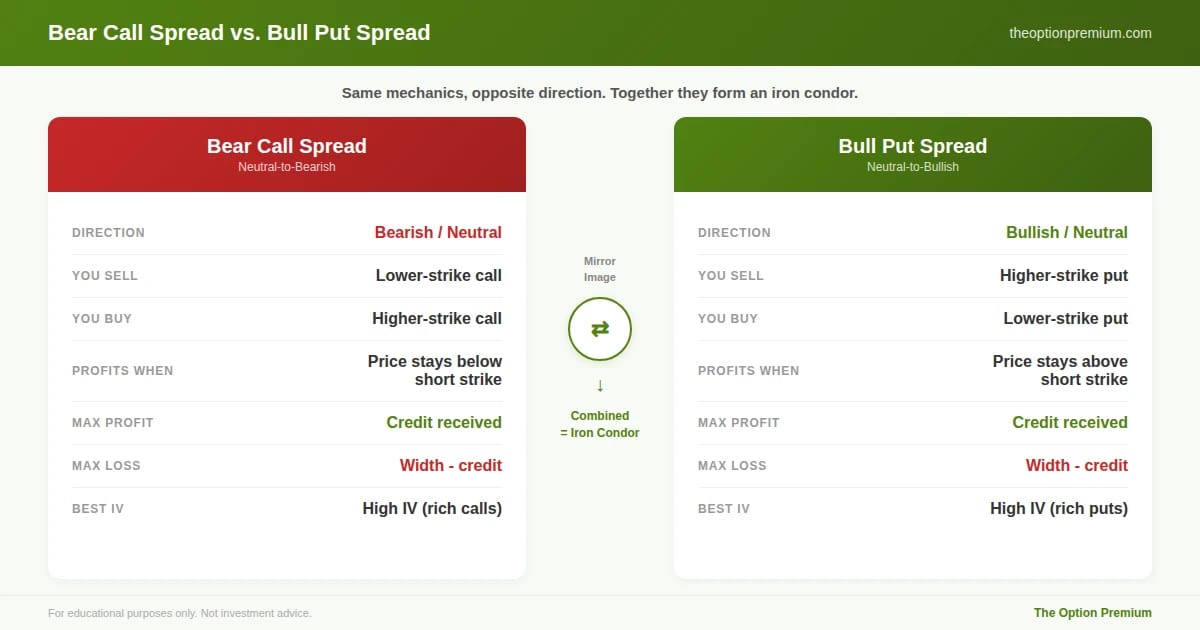
Bear call spread vs bull put spread comparison showing how they mirror each other and combine into iron condors
Manage at 50-65% of max profit. I rarely hold bear call spreads to expiration. When the position reaches 50-65% of the credit received, I close it. This locks in gains, frees up capital, and avoids the gamma risk that comes with the final week before expiration. Boring? Yes. Profitable over hundreds of trades? Absolutely.
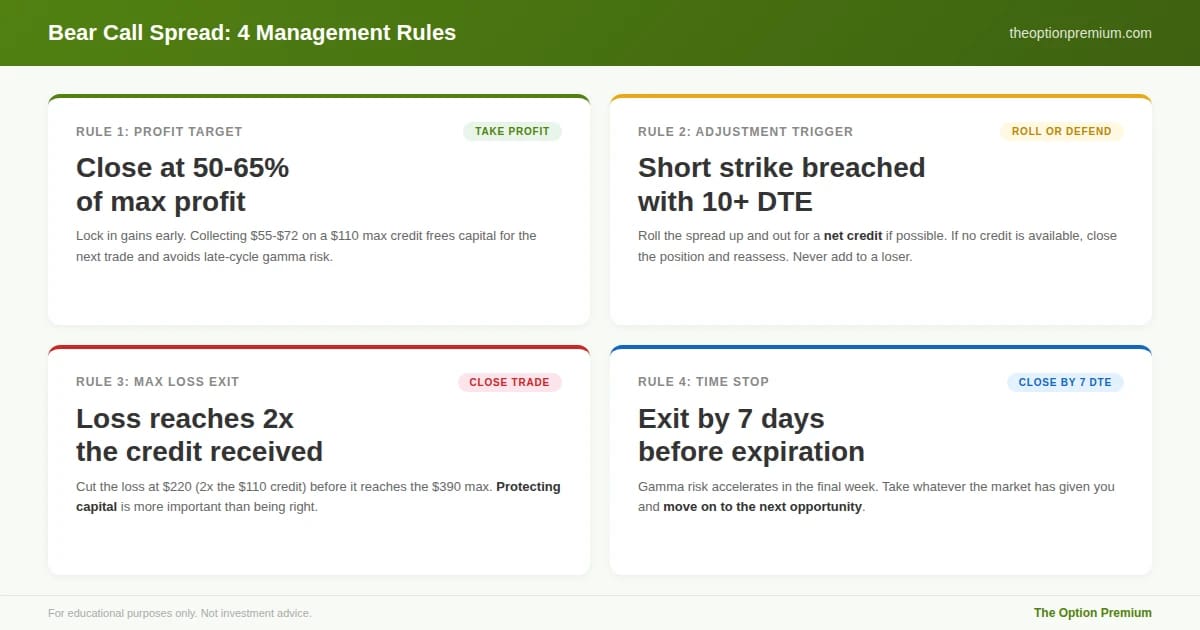
Four bear call spread trade management rules: profit target, adjustment trigger, max loss exit, and time stop
Respect the rally. Bear call spreads lose when the underlying moves sharply higher. I always know my adjustment point before I enter. If the short strike is breached with more than 10 days remaining, I either roll the spread up and out for a credit, or I close and move on. No hoping, no praying. Just execution.
Risk Reality Check
Bear call spreads are defined-risk, but that doesn't mean the risk is small. A $5-wide spread with a $1.10 credit means you're risking $3.90 to make $1.10. That's a risk/reward ratio of roughly 3.5:1 against you on any single trade.
The math works because probability is on your side. You win 75-80% of the time. But that also means one in four or five trades will lose, and those losses are larger than the wins. This is why position sizing matters more than strike selection. If you risk too much per trade, a normal losing streak can create an outsized drawdown.
The other risk to respect: early assignment. While rare with call spreads (especially on indexes and ETFs), it can happen with individual stocks approaching ex-dividend dates. Stick to cash-settled indexes or ETFs with no dividend risk, and this becomes a non-issue.
Key Takeaways

A bear call spread is a defined-risk credit strategy that profits when the underlying stays below your short strike. It's the bearish counterpart to the bull put spread.
Place your short call at the 0.15 to 0.25 delta range for a 75-85% probability of profit, and target the 30 to 45-day expiration window.
Manage winners at 50-65% of max profit rather than holding to expiration. This reduces gamma risk and improves your long-term win rate.
Position sizing is your real edge. The risk/reward on individual trades runs against you, so the strategy only works when you size appropriately and let probability play out over dozens of trades.
Bear call spreads pair naturally with bull put spreads to form iron condors, giving you the flexibility to leg into trades based on where IV is richest.
Final Thought
Bear call spreads aren't flashy. You won't see them trending on social media or hyped in trading chat rooms. But for premium sellers who understand that consistency beats excitement, they're an essential tool for generating income in neutral-to-bearish environments.
The best traders I know aren't the ones with the biggest wins. They're the ones who can profit regardless of direction. Bear call spreads give you that ability.
Trade Smart. Trade Thoughtfully.
Andy Crowder
📩 Want to see how a 24+ year professional options trader approaches the market?
Subscribe to The Option Premium, my free weekly newsletter where I share:
Probability-based strategies that actually work: credit spreads, cash-secured puts, the wheel, LEAPS, poor man's covered calls, and more
Real trade breakdowns with the math behind every decision
Market insights for any environment, whether we're grinding higher, pulling back, or chopping sideways
No hype. No predictions. Just the frameworks I've used to trade options for over two decades.
📺 Want more? Follow me on YouTube for in-depth tutorials, live trade analysis, and the kind of education you won't find anywhere else.
Connect with me:
This newsletter is for educational purposes only and should not be considered investment advice. Options trading involves significant risk and is not suitable for all investors. Past performance does not guarantee future results. Always consult with a qualified financial professional before making investment decisions.
Reply